

As an Amazon Associate we earn from qualifying purchases.
- Best overall: Celestron AstroMaster 130EQ Telescope
- Best budget: Celestron AstroMaster 70AZ Telescope
- Best premium: Vortex Diamondback HD 12×50 Binoculars
- Best for travel: Vortex Diamondback HD 8×42 Binoculars
- Celestron AstroMaster telescopes are designed for viewing the Moon, planets and other distant celestial targets.
- Vortex Diamondback HD binoculars are versatile choices for wildlife, travel and wide-field sky viewing.
- The Celestron AstroMaster 130EQ offers the largest aperture among the telescope picks, at 130mm.
- The Vortex Diamondback HD 8×42 balances a wide field of view with manageable 8x magnification.
- Choose based on what you want to observe: telescopes specialize in the sky, while binoculars work across more everyday settings.
Celestron AstroMaster telescopes and Vortex Diamondback HD binoculars serve different observing needs, so the right Black Friday 2026 pick depends on what you want to see. AstroMaster models collect light through a telescope aperture and pair with mounts for aiming at the Moon, planets and star clusters. Diamondback HD binoculars provide a portable, two-eye view for wildlife, scenery and casual skywatching.
We researched and compared specs, reviews and owner feedback to identify useful choices across both families. The Best bet for dedicated astronomy is a Celestron AstroMaster telescope with an aperture suited to your storage space and setup preferences. For a wider range of outdoor uses, Vortex Diamondback HD binoculars offer a simpler grab-and-go option. The models below are not interchangeable; the guide explains their strengths so you can match the instrument to your plans.
How We Picked
- Compared aperture, magnification and optical configuration for the Celestron AstroMaster telescope models.
- Reviewed magnification, objective-lens diameter, field of view and eye relief for Vortex Diamondback HD binoculars.
- Considered setup, portability and mount style, including whether a model is better suited to stationary astronomy or outdoor viewing.
- Used published specifications alongside reviews and owner feedback to highlight practical strengths and trade-offs.
- Selected models that represent distinct use cases rather than treating telescopes and binoculars as direct substitutes.
Comparison Table
| Product | Best for | Optical specification | Mount or field of view | Best use |
|---|---|---|---|---|
| Celestron AstroMaster 70AZ Telescope | New astronomers | 70mm aperture | Manual altazimuth mount | Moon and bright planets |
| Celestron AstroMaster 90AZ Telescope | Refractor beginners | 90mm aperture | Manual altazimuth mount | Lunar and planetary viewing |
| Celestron AstroMaster 130EQ Telescope | Aperture-focused astronomy | 130mm aperture | Manual equatorial mount | Broader sky exploration |
| Celestron AstroMaster 114EQ Telescope | Reflector learners | 114mm aperture | Manual equatorial mount | Moon and bright planets |
| Vortex Diamondback HD 8×42 Binoculars | Wildlife and travel | 8x magnification | 393 feet at 1,000 yards | Wide-field handheld viewing |
| Vortex Diamondback HD 10×42 Binoculars | Birding and distant subjects | 10x magnification | 346 feet at 1,000 yards | Extra handheld reach |
| Vortex Diamondback HD 10×50 Binoculars | Low-light outdoor viewing | 10x magnification | 315 feet at 1,000 yards | Brighter wide-field views |
| Vortex Diamondback HD 12×50 Binoculars | Distant stationary subjects | 12x magnification | 271 feet at 1,000 yards | High-power viewing |
Best Picks Reviewed
#1
Celestron AstroMaster 70AZ Telescope
The Celestron AstroMaster 70AZ Telescope is the best beginner telescope for casual Moon and planet viewing, with a 70mm aperture and straightforward manual altazimuth mount.

Best for: New astronomers who want simple setup
- Aperture
- 70mm
- Focal length
- 900mm
- Mount
- Manual altazimuth
- Simple up-down and side-to-side aiming
- Long focal length supports useful lunar and planetary views
- Refractor design needs no mirror collimation
- Smaller aperture gathers less light than larger AstroMaster models
Is the Celestron AstroMaster 70AZ Telescope worth buying on Black Friday 2026?
The Celestron AstroMaster 70AZ Telescope is a worthwhile choice for beginners who want a simple instrument for the Moon and bright planets. The Celestron AstroMaster 70AZ Telescope's 70mm aperture and manual altazimuth mount prioritize approachable setup over deep-sky light gathering.
See today’s Black Friday price on Amazon
#2
Celestron AstroMaster 90AZ Telescope
The Celestron AstroMaster 90AZ Telescope is the best refractor pick for beginners seeking a brighter view, with a 90mm aperture and manual altazimuth mount.
Best for: Lunar and planetary viewing with a refractor
- Aperture
- 90mm
- Focal length
- 1000mm
- Mount
- Manual altazimuth
- Larger aperture than the 70AZ
- Refractor optics offer low-maintenance use
- Simple mount supports quick pointing
- Long tube takes more storage space than compact binoculars
Is the Celestron AstroMaster 90AZ Telescope worth buying on Black Friday 2026?
The Celestron AstroMaster 90AZ Telescope is worth considering for beginners who want a refractor with more light-gathering ability than a 70mm model. The 90mm aperture and 1000mm focal length suit lunar and bright planetary observing.
See today’s Black Friday price on Amazon
#3 · Top pick
Celestron AstroMaster 130EQ Telescope
The Celestron AstroMaster 130EQ Telescope is the best AstroMaster pick for broader sky exploration, pairing a 130mm aperture with an equatorial mount.
Best for: Aperture-focused astronomy beginners
- Aperture
- 130mm
- Focal length
- 650mm
- Mount
- Manual equatorial
- Largest aperture among the listed AstroMaster telescopes
- Shorter focal length supports wider views
- Equatorial mount can track targets with coordinated movement
- Equatorial setup takes more learning than an altazimuth mount
Is the Celestron AstroMaster 130EQ Telescope worth buying on Black Friday 2026?
The Celestron AstroMaster 130EQ Telescope is a strong choice for buyers who prioritize aperture for astronomy. The Celestron AstroMaster 130EQ Telescope's 130mm reflector gathers more light than the smaller AstroMaster options, while the equatorial mount rewards time spent learning alignment and tracking.
See today’s Black Friday price on Amazon
#4
Celestron AstroMaster 114EQ Telescope
The Celestron AstroMaster 114EQ Telescope is the best middle-ground reflector for buyers seeking a 114mm aperture and an equatorial mount.
Best for: Astronomy learners who want a reflector
- Aperture
- 114mm
- Focal length
- 1000mm
- Mount
- Manual equatorial
- Reflector design provides a sizable aperture
- Equatorial mount supports following sky motion
- Long focal length suits lunar and planetary targets
- Requires more setup learning than a simple altazimuth telescope
Is the Celestron AstroMaster 114EQ Telescope worth buying on Black Friday 2026?
The Celestron AstroMaster 114EQ Telescope is a worthwhile reflector for astronomy learners who want a 114mm aperture and equatorial tracking. The design suits Moon and bright-planet viewing, though beginners should allow time to learn mount alignment.
See today’s Black Friday price on Amazon
#5
Vortex Diamondback HD 8×42 Binoculars
The Vortex Diamondback HD 8×42 Binoculars are the best all-around binoculars for travel and wildlife, with 8x magnification and 42mm objective lenses.
Best for: Wildlife, travel and relaxed skywatching
- Magnification
- 8x
- Objective lens
- 42mm
- Field of view
- 393 feet at 1,000 yards
- Close focus
- 5 feet
- Wide field of view makes moving subjects easier to follow
- 8x magnification is manageable for handheld viewing
- Useful for outdoor activities beyond astronomy
- Less magnification than the 10x and 12x options
Are the Vortex Diamondback HD 8×42 Binoculars worth buying on Black Friday 2026?
The Vortex Diamondback HD 8×42 Binoculars are a practical all-around choice for wildlife, travel and casual skywatching. Their 8x magnification and 393-foot field of view support steady handheld viewing and quick tracking of moving subjects.
See today’s Black Friday price on Amazon
#6
Vortex Diamondback HD 10×42 Binoculars
The Vortex Diamondback HD 10×42 Binoculars are the best compact option for extra reach, combining 10x magnification with 42mm objective lenses.
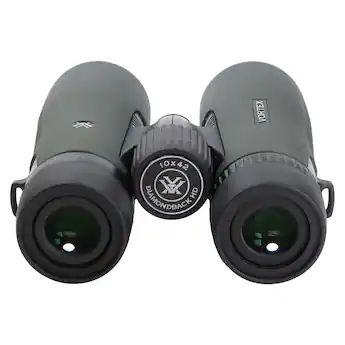
Best for: Birding and distant daytime subjects
- Magnification
- 10x
- Objective lens
- 42mm
- Field of view
- 346 feet at 1,000 yards
- Close focus
- 5 feet
- More reach than an 8x binocular
- 42mm objectives balance light gathering and portability
- Close focus supports nearby subjects
- Narrower field of view than the 8×42 model
Are the Vortex Diamondback HD 10×42 Binoculars worth buying on Black Friday 2026?
The Vortex Diamondback HD 10×42 Binoculars are worth considering for birding and distant subjects when additional magnification matters. Their 346-foot field of view is narrower than the 8×42 version, so fast-moving targets take more deliberate tracking.
See today’s Black Friday price on Amazon
#7
Vortex Diamondback HD 10×50 Binoculars
The Vortex Diamondback HD 10×50 Binoculars are the best Diamondback pick for brighter low-light viewing, with 10x magnification and 50mm objective lenses.
Best for: Low-light outdoor viewing and astronomy
- Magnification
- 10x
- Objective lens
- 50mm
- Field of view
- 315 feet at 1,000 yards
- Close focus
- 6 feet
- 50mm objectives gather more light than 42mm models
- 10x magnification gives useful detail at a distance
- Works for outdoor viewing and wide-field astronomy
- Larger objectives add bulk compared with 42mm binoculars
Are the Vortex Diamondback HD 10×50 Binoculars worth buying on Black Friday 2026?
The Vortex Diamondback HD 10×50 Binoculars are a strong option for outdoor viewers who value larger objectives and 10x reach. The 50mm lenses suit dimmer scenes and wide-field sky viewing, while the larger body is less compact than a 42mm pair.
See today’s Black Friday price on Amazon
#8
Vortex Diamondback HD 12×50 Binoculars
The Vortex Diamondback HD 12×50 Binoculars are the best high-magnification pick for distant stationary subjects, with 12x power and 50mm objectives.
Best for: Distant scenery and supported sky viewing
- Magnification
- 12x
- Objective lens
- 50mm
- Field of view
- 271 feet at 1,000 yards
- Close focus
- 6 feet
- Highest magnification in this binocular selection
- 50mm objectives help in dimmer viewing conditions
- Suitable for distant details and celestial sweeps
- Higher magnification makes handheld shake more noticeable
Are the Vortex Diamondback HD 12×50 Binoculars worth buying on Black Friday 2026?
The Vortex Diamondback HD 12×50 Binoculars are a good fit for distant, relatively stationary subjects and supported sky viewing. Their 12x magnification reveals more detail than lower-power picks, but a steady grip or support helps control image shake.
See today’s Black Friday price on Amazon
Are Celestron AstroMaster telescopes or Vortex Diamondback binoculars better for astronomy?
Celestron AstroMaster telescopes are better for detailed astronomy, while Vortex Diamondback HD binoculars suit broad, portable sky viewing. A telescope’s larger aperture and higher magnification make it a better fit for observing the Moon’s features and bright planets. An AstroMaster 130EQ, for example, has a 130mm aperture.
Binoculars are easier to carry and point, and their two-eye view feels natural for scanning star fields. The Vortex Diamondback HD 8×42 gives a 393-foot field of view at 1,000 yards, a useful trait for sweeping across the sky. Binoculars do not replace a telescope for detailed planetary observing.
Choose a telescope when astronomy is the main purpose and a binocular when you want one instrument for nature, travel and occasional stargazing.
Which Celestron AstroMaster telescope is best for a beginner?
The Celestron AstroMaster 70AZ Telescope is the simplest beginner choice, with a 70mm aperture and a manual altazimuth mount. The mount moves intuitively up, down and across, making it easier to aim without learning equatorial alignment. A compact setup and low-maintenance refractor design also help keep the first observing sessions approachable.
Buyers who want a larger refractor can consider the 90AZ, while the 130EQ provides the largest aperture among the telescope options here. The 114EQ and 130EQ use equatorial mounts, which take more setup practice but help follow the apparent movement of the sky.
For a first telescope, prioritize a mount you feel comfortable operating and a size you can store and carry. Aperture matters, but complicated setup can keep an otherwise capable instrument indoors.
Which Vortex Diamondback HD binoculars should I choose?
The Vortex Diamondback HD 8×42 Binoculars are the best general-purpose pick, while the 10×42, 10×50 and 12×50 models trade field width, reach and size. An 8x binocular is easier to hold steadily and offers a wider view for wildlife and moving subjects.
Choose 10×42 for added reach in a compact format, or 10×50 for larger objective lenses that support dimmer viewing. The 12×50 brings the most magnification in this selection, which suits distant details but makes hand movement more noticeable. A tripod or other support helps with steadiness.
Think about your usual light conditions and how long you carry binoculars. A larger objective lens is useful for low-light viewing, but a lighter 42mm model is often easier to bring along for a full day outdoors.
Can binoculars replace a telescope for stargazing?
Vortex Diamondback HD binoculars can complement a telescope for stargazing, but they do not replace a telescope for detailed lunar and planetary views. Their wide field makes it easy to scan star patterns, follow the Moon and get familiar with the night sky.
A telescope gathers light through one larger objective and supports higher magnification. The Celestron AstroMaster 90AZ has a 90mm aperture, while the Diamondback HD binocular models use 42mm or 50mm objectives per barrel. Their observing styles and capabilities differ, even when both are pointed at the sky.
For beginners, binoculars are an inviting way to learn the sky and check observing conditions. For detail, a telescope is the more suitable dedicated instrument. Some shoppers keep binoculars for quick sessions and use a telescope when they want a closer look.
What should I look for in a Black Friday 2026 telescope or binocular?
For a Black Friday 2026 optics purchase, compare the product’s intended use, optical specifications and setup demands before choosing between a telescope and binocular. Telescope aperture, focal length and mount design affect what you see and how easily you point at a target.
For binoculars, compare magnification, objective-lens diameter, field of view and close focus. Lower magnification typically gives a wider view and steadier handheld image; larger objectives suit dimmer conditions but add bulk. Eye relief also matters for comfortable viewing, especially for people who wear glasses.
Check what is included in the package and confirm that the listed model and variant match your needs. A telescope for mostly urban lunar viewing has different priorities from binoculars intended for hiking, birding or travel.
Buying Guide
Start with the activity
Pick a telescope for detailed astronomy and binoculars for flexible outdoor use. The Celestron AstroMaster models focus on distant celestial targets, while Vortex Diamondback HD binoculars work for wildlife, scenery and casual stargazing.
Compare aperture and objective size
A larger telescope aperture collects more light, while binocular objective diameter affects light gathering and overall size. The AstroMaster 130EQ has a 130mm aperture; Diamondback HD options use 42mm or 50mm objectives.
Match magnification to steadiness
Higher binocular magnification brings distant details closer but makes hand movement more apparent. Choose 8x for a broad, steady view or 10x and 12x for more reach. Telescope magnification also depends on the eyepiece used.
Consider setup and portability
Altazimuth telescope mounts move intuitively, while equatorial mounts require alignment practice. Binoculars are easier to pack and deploy, but larger 50mm models take more room than 42mm versions.
Check comfort and included accessories
Review eye relief, focus controls, mount components and supplied accessories for the exact variant. Comfortable viewing and a complete setup matter as much as headline magnification when choosing optics for regular use.
FAQ
Celestron AstroMaster vs Vortex Diamondback: which is better for stargazing?
Celestron AstroMaster telescopes are better for detailed views of the Moon and bright planets. Vortex Diamondback HD binoculars are easier to carry and better for scanning star fields. The right choice depends on whether astronomy is your main activity or one use among several.
Which Celestron AstroMaster telescope has the largest aperture?
The Celestron AstroMaster 130EQ Telescope has the largest aperture among the AstroMaster models in this guide, at 130mm. Its reflector design and equatorial mount suit buyers who prioritize light gathering and are comfortable learning a more involved setup.
Are 8×42 or 10×42 binoculars better for birding?
Vortex Diamondback HD 8×42 Binoculars suit birders who value a wider field and steadier handheld viewing. Vortex Diamondback HD 10×42 Binoculars bring distant subjects closer, with a narrower field. Choose based on whether tracking or extra reach matters more.
Are 10×50 binoculars good for astronomy?
Vortex Diamondback HD 10×50 Binoculars are useful for wide-field astronomy because 10x magnification pairs with 50mm objective lenses. The larger objectives support dimmer viewing than 42mm options, while the binocular format remains easier to carry than a telescope.
What is the difference between AstroMaster 70AZ and 90AZ?
The Celestron AstroMaster 70AZ Telescope has a 70mm aperture and 900mm focal length, while the Celestron AstroMaster 90AZ Telescope has a 90mm aperture and 1000mm focal length. Both use manual altazimuth mounts; the 90AZ gathers more light.
Are 12×50 binoculars too powerful to hold by hand?
Vortex Diamondback HD 12×50 Binoculars are usable handheld, but their 12x magnification makes image shake more noticeable than with 8x models. A steady stance helps, and a support is useful for longer sessions or careful viewing of distant subjects.